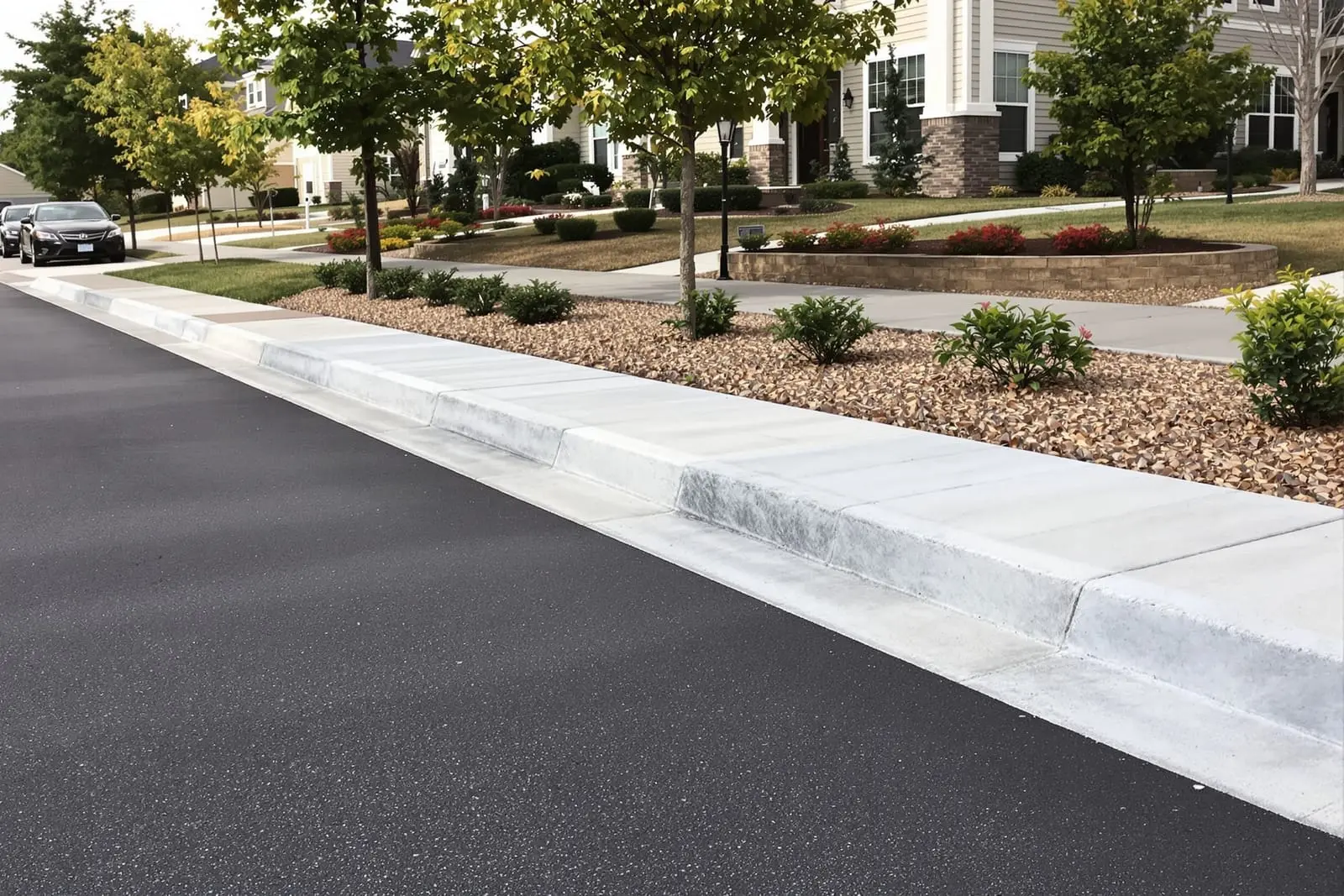
Control water and traffic with concrete curb and gutter in Las Vegas, NV. We install standard and rolled curbs, gutters, and barriers for parking lots, streets, and commercial sites. Properly placed curbs help manage drainage and protect landscaping and structures.
Primetime Concrete Las Vegas provides professional concrete curb and gutter throughout Las Vegas, NV and the surrounding area. Our licensed, insured crew delivers safe, clean, on-time work with a free estimate before anything begins. Call (702) 761-3986 or request your free quote.
Practical Concrete Curb and Gutter Solutions in Las Vegas
Primetime Concrete Las Vegas installs and repairs concrete curb and gutter systems that actually work in our local conditions. In the valley, the curb line is not just about looks. It controls how stormwater moves across your property, protects asphalt edges from breaking apart, and keeps parking and drive lanes clearly defined.
For homes, we typically install straight and rolled curbs along driveways, RV parking areas, and perimeter property lines to stop gravel migration and protect landscaping. For commercial lots, we focus on continuous curb and gutter runs that tie into existing drainage structures, meet ADA requirements at ramps, and hold paint striping without crumbling at the edges.
Because our soil is mostly compacted fill and caliche, we pay close attention to base prep so you do not end up with curbs that tip, crack, or separate from your asphalt. Everything starts with layout on the ground, not just on a drawing, so elevations actually match the way water falls across your property, not how someone hoped it would on paper.
How We Install Curbs, Gutters, and Barriers Step by Step
Our crew follows a clear sequence so your concrete curb and gutter or barrier goes in right the first time.
1) Layout and elevations: We snap chalk lines and use laser levels to set curb alignment and flow direction. In Las Vegas, we usually set at least a 1 percent slope so water does not pond and create algae or mosquito issues.
2) Excavation and base prep: We trench to the required depth, usually 6 to 8 inches below finished height for residential and 8 to 12 inches for commercial curb and gutter. We compact the subgrade using plate compactors or rollers and bring in Class II or Type II base as needed so the curb is bearing on solid material, not loose backfill.
3) Forms and reinforcement: For machine‑poured curb and gutter, we use a curb machine on larger runs. For smaller or more complex areas, we hand form using steel or wood forms pinned every 2 to 3 feet. On driveways, entrances, or truck routes, we often add rebar dowels or #3 or #4 bars inside the curb to reduce cracking and separation from the pavement.
4) Concrete placement and finishing: We typically pour 3,000 to 4,000 psi concrete, adjusted with the right slump so it holds shape but still consolidates around forms. We rod and float the surface, then edge the curb top and gutter pan. At transitions to sidewalks or ramps, we use straightedges and templates so your inspector has no issue with slopes or lips.
5) Joints and curing: We place control joints every 8 to 10 feet on residential work and 10 to 12 feet on commercial, unless plans call for something different. Joints are cut or tooled to at least one quarter of slab thickness. We then apply a curing compound or keep the concrete moist so it gains strength properly in the dry desert air.
6) Strip‑out and cleanup: Once the concrete has set, we strip forms, clean the gutter pans, and backfill edges if needed. On commercial sites, we coordinate with your striping or paving contractor so schedules line up and the curb is not damaged by early traffic.
Curb, Gutter, and Barrier Options That Actually Fit Your Property
Primetime Concrete Las Vegas offers different curb, gutter, and barrier profiles because not every property needs the same thing.
For residential work, the most common features are driveway curbs, rolled curbs for easier vehicle access, and small barrier curbs along planters or property edges. Many homeowners in older Las Vegas neighborhoods call us to replace broken street‑side curbs where tree roots or years of trash trucks have caused heaving. In those cases, we match the existing profile so your replacement section blends into the rest of the street.
On commercial and HOA properties, we see a lot of need for heavy‑duty parking lot curbs, wide gutter pans for fast storm runoff, and low profile curbs at ADA ramps and building entrances. We can pour traditional 6 inch vertical curb, type D curb and gutter, or custom profiles required by city or county plans. For truck courts, loading docks, or service alleys, we often upsize concrete strength and use thicker curb bases to handle repeated impact.
For barrier work, you can choose between poured in place wheel stops, continuous concrete barriers along property lines, or thicker retaining‑style curbs to hold back decorative rock and landscape slopes. In high traffic areas, we round edges more and sometimes tint the concrete or add integral color so drivers can see raised edges clearly, especially at night under parking lot lights.
Finishing options include plain broom finishes for most curb and gutter, light texture for better traction at crosswalks, and smooth trowel only where plans specifically call for it. We can also embed sleeves or stubs in the curb line for future fencing, bollards, or signage so you avoid drilling and patching later.
What Drives the Cost of Concrete Curb and Gutter in Las Vegas
Pricing for concrete curb and gutter and barriers depends on several specific factors. Knowing these upfront helps you compare quotes fairly.
Length and complexity: Straight runs along a simple edge are the most efficient. Once we add curves, changes in height, tight radiuses at parking islands, or steps in elevation, labor time goes up. Short scattered sections around an existing property usually cost more per linear foot than one long continuous run because of setup and cleanup time.
Access and existing conditions: If we can get a ready‑mix truck right up to the pour area, costs stay lower. When we have to wheelbarrow long distances, pump concrete, or work in tight courtyards or backyards, labor adds up. Breaking out and hauling away old curb, asphalt, or roots is another cost driver that depends on how much demo is needed.
Thickness, strength, and reinforcement: Standard residential curbs often use 3,000 psi concrete without rebar, as long as the base is properly compacted. Commercial or heavy traffic curbs typically need 4,000 psi concrete, thicker bases, dowels into existing slabs or asphalt, or continuous rebar. Each of these adds material and installation time.
Permits, inspections, and traffic control: Street‑side curb and gutter that ties into public right of way usually involves city or county permits and inspections. In some Las Vegas jurisdictions, we also need traffic control plans or lane closures. Primetime Concrete Las Vegas can coordinate this, but the fees and extra labor are part of the total cost.
We provide written proposals that list removal, base prep, forming, pouring, and cleanup separately where it makes sense so you can see exactly where your money is going.
Common Local Problems With Curbs, Gutters, and Barriers and How We Fix Them
Las Vegas has specific conditions that are tough on concrete curbs, gutters, and barriers. Our crews deal with these issues regularly and plan for them in the design and installation.
One of the biggest problems is settlement along edges where utilities were previously trenched or where fill was not compacted correctly. This leads to gutter pans that hold water instead of draining. When we repair or replace these sections, we dig out soft spots, recompact the subgrade in thin lifts, and in problem areas use thicker base rock or controlled low strength material under the new curb and gutter to bridge weak zones.
Another common issue is curb cracking at driveway aprons and entrances where vehicles drop off pavement and impact the curb edge. In those spots, we usually pin the new curb into the existing slab or asphalt with dowels and sometimes increase the curb width and depth. This spreads impact loads and keeps the curb from shearing off.
We also see deterioration from irrigation overspray and constant moisture against the curb face, especially where drip lines or sprinklers are set too close. While concrete is water resistant, constant saturation can cause staining, efflorescence, and scaling. When we replace these runs, we often recommend adjusting irrigation, raising grades, or using a slightly denser mix and proper curing so the surface is more durable.
With barriers and wheel stops, the most frequent complaint is movement and misalignment. Light precast stops get pushed around by vehicles and are a tripping hazard when they shift. Our solution is poured in place or pinned wheel stops tied into the slab or base so they stay where they are supposed to be. In areas with frequent snowbird traffic and rental cars, clear painted striping against solid curbs and stops helps guide drivers and cut down on property damage.
What to Expect When You Hire Primetime Concrete Las Vegas
When you contact Primetime Concrete Las Vegas for concrete curb and gutter or barrier work, we start with a site visit, not just a phone estimate. We walk the area with you, look at slopes, drains, pavement conditions, and traffic patterns, then measure and mark proposed lines so you can see exactly what will be poured.
For residential projects, we schedule work to minimize downtime for driveways and access. Typically, we plan demolition and forming on day one, concrete placement on day two, and light access after 24 to 48 hours depending on temperatures. Full vehicle traffic is usually allowed after a few days once the concrete achieves sufficient strength.
On commercial projects, we coordinate phases so not all parking or drive lanes are closed at the same time. We can work early mornings or off hours if needed so businesses stay operational. Our crews are used to working around other trades like pavers, stripers, landscapers, and utility contractors, and we sequence our work so their schedules are not disrupted.
Before we leave, we verify slopes with a level or laser, check joints for proper spacing, and review all visible surfaces with you. You will know where joints are, which sections are structural or decorative, and how long to keep traffic off the new work. We also explain basic care, such as avoiding deicing salts in the first season and keeping heavy equipment away until the concrete has fully cured.
The goal is simple. Your curbs, gutters, and barriers should move water where it belongs, withstand the traffic they see every day in Las Vegas, and look clean and intentional along the edges of your property.
“
Professional curbs, gutters & concrete barriers, done right the first time, quality materials, honest pricing, and results that last.
Primetime Concrete Las Vegas
Curbs, Gutters & Concrete Barriers Across Our Service Area